
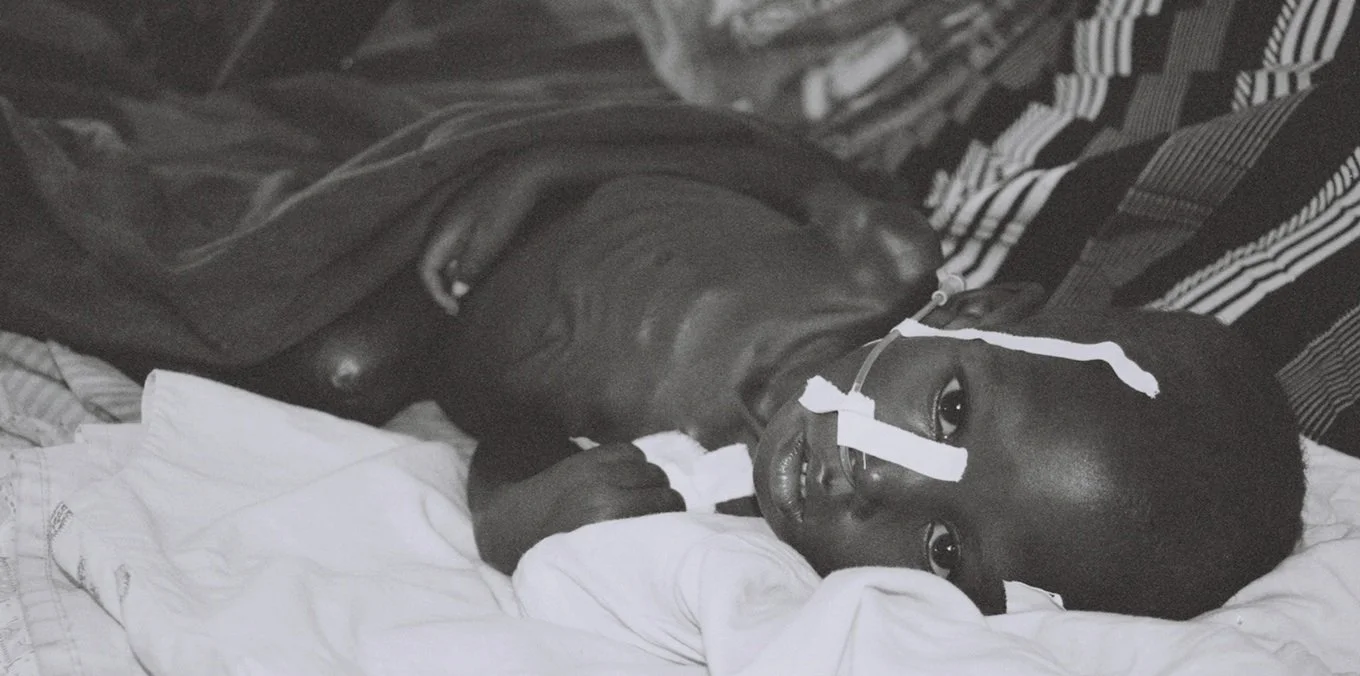
Jacob
I remember the moment I first saw Jacob as if it were yesterday.
I was in the middle of a five-month stay in Nimule, South Sudan. I’d spent my first few weeks helping to care for children at an orphanage and assisting in delivering babies in the maternity ward at the local hospital. On the day I met Jacob, I was standing outside the wide doorway to the pediatric ward with my friend and teacher, Dr. Denis.
The air drifting out from the ward was thick and hot. With every breath I took, the smell of dirt and sickness seemed to grow a little stronger. During my time in Nimule, my idea of what a hospital was had changed. It was no longer a modern building with pristine equipment, self-contained patient rooms, electric beds, and the steady hum of air conditioning. Now it was a network of small, overcrowded wards that could have been constructed in the 19th century.
The patients at Nimule Hospital lay on green mattresses, waiting to get better—or worse. They had no privacy; each ward was simply one long rectangular room with two rows of beds. Some patients were hooked up to IVs, but no one was connected to any machines. If someone’s heart stopped, no alarm would blare. Amid these seemingly impossible conditions, a few doctors and a handful of nurses fought to save as many lives as they could.
Standing on the threshold of the pediatric ward, I could feel the stale air sticking to my skin in the heat of the day. I peered inside and saw mothers and children sitting or stretched out on the beds. No one seemed to be moving, even though I could hear the cries of some of the children. Denis told me that each child was battling malnutrition, malaria, and/or other ailments that had become all too familiar due to the civil war and its aftermath. I inhaled deeply, exhaled, and then Denis and I took our first steps into the ward.
We moved from bed to bed, checking the health of one child after another. On the wall above each bed, a number was written in white paint. Eventually we reached bed number six, where I saw a fragile boy lying atop a mess of sheets. His eyes captured me first: deep brown, glistening, and somehow out of place amid his wasted body. He was small, naked, and his skin was pulled tightly across his bones. He had wounds on his buttocks, back, and behind his ears due to severe malnutrition. Even in his debilitated state, he was beautiful.
Denis told me the boy’s name was Jacob. My mind immediately went to another child from a distant time:
Jacob, the son whom God had promised to Abraham. Jacob, the child who would grow to become the father of many nations. Jacob, who would later receive the name Israel.
The Jacob lying in the hospital bed in front of me was three years old and weighed just over 12 pounds. I studied his quiet face and then glanced at the nurses nearby. I could tell by the looks on their faces that they were scared—scared that Jacob had HIV and scared that fighting for his life would be pointless.
As we approached his bed, his eyes drew me in, and something inside me began wrestling with my role in his healing process.
I will never get used to this, I thought to myself. A wave of emotions suddenly crashed over me, and I felt paralyzed as I stood at his bedside.
“Murielle,” Denis said, speaking my name and waking me from my thoughts, “you will clean his wounds today.” It took me a few moments to find my voice again.
“I don’t know if I can,” I finally managed to say.
“Of course you can,” he replied. “You have cleaned many wounds before.”
That wasn’t the point. I had cleaned many wounds—some of them awful—but this felt different. There was something about this boy, and my heart was aching because of it. Perhaps I, too, was scared that fighting for his life would be pointless. I knew that if I chose to care for him, it meant loving him. That is what God had put in my heart when I first came to Africa—to love the unlovable. And loving him meant facing the very real possibility of losing him. I knew this because I had loved and lost before. Death was not unfamiliar to me, so I found myself wrestling with whether or not to accept the risk of losing someone again.
I cleaned Jacob’s wounds that day. I knelt over the bed, gloved my hands, and spoke softly to him as I scrubbed his deep wounds. I held back tears as blood rose to the surface of his injuries. His skin was hot and dry against mine. His eyes met my own. Trying to comfort him, I spoke, sang softly, and prayed. I prayed for healing for him, courage for me, and that somehow, amid all this pain, Jacob would feel God’s presence holding him.
I could feel myself falling in love with this orphaned boy. It was that love that drew me back, day after day, to the hard task of inflicting pain in order to bring healing. Each day I would wrap my left hand under his head to comfort him, then bend down to kiss his face.
“Miriam! Do not kiss the child,” one of the nurses exclaimed. “You will get disease.” (The nurses and almost everyone else in Nimule called me Miriam.)
“I am not worried about disease,” I replied. “I want to live without regret.” (In truth, I did worry about disease, but my desire to live without regret helped me move past the fear.) I wanted this frail, suffering child to know that he was loved, that he was not alone, and that he was not forgotten.
For the next two months, I cleaned Jacob’s wounds. I also spent time sitting with him, reading him stories, and kissing his face. Each day I would look into those beautiful, glistening, big brown eyes and see them staring back at mine. More and more life returned to those eyes, and the wounds became superficial rather than deep. I looked forward to the day when I would see Jacob walk and hear him laugh.
The news of Jacob’s death fell heavy on my heart. Like the deep, soaking rains that drench the land during the rainy season in Nimule, the grief swept through me and pounded in my heart. It was an unrelenting storm.
Denis had been looking after Jacob while I was away for a few days in Kenya. I was sitting in a small internet café when I found out. A friend had sent an email telling me that Jacob had contracted a chest infection and the hospital was unable to obtain the antibiotic needed to treat him. My head suddenly went blurry; the entire world seemed to stop.
I loved him, and I lost him.
For the first few days, I couldn’t even cry. My tears were trapped somewhere inside me. Even in my most desperate moments alone in bed at night, I could not bring myself to weep. This was not my first experience with death, but I wanted it to be my last. I would remember what it was like to hold him, to hope, to finally see him smile—and I was undone. So I told God I would never go back to the hospital. I didn’t want to see the bed where I had held him in my arms. I didn’t want to remember the days I cleaned his wounds, cared for him, and loved him. I felt as though everything God had spoken to me about His love and His plans for me in South Sudan had shattered.
For a while, I managed to avoid the hospital. I busied myself by increasing my work at the orphanage and tending to various tasks around the Nimule community. Denis came by and encouraged me: “You need to come back. There are others like him.” But I had no room left; I had no hope.
I don’t know if you’ve ever said no to God, but in my experience, He always finds a way to bring me back to His heart. It’s as if His greater love and better plan eventually catch up to me. And so Peace came.
Peace was a tiny baby, about three months old. His father, who had a disability from an old war wound, arrived at the compound where I was staying about a week after Jacob died. Peace was clothed in an ill-fitting baby sling that was soaked in blood. Some of the children I stayed with came rushing over, shouting, “Mama Miriam! You come! You come!” I ran across the rocky dirt between us, saw Peace, and was filled with anger and urgency.
“Why have you brought him here and not to the hospital?” I asked. There was no time to wait for an answer. I took Peace in my arms and ran with him down the narrow path and onto the dirt road to the hospital. As I ran, I felt God gently impress upon me the question: You will never go back? It was a soft nudging at the edges of my heart. He knew what it would take to draw me back. I felt it was the beginning of God pulling me back to His heart.
Peace was admitted to the hospital that night. He was severely dehydrated, malnourished, and had a bladder infection. The next morning, I went to feed him and check on his condition. At Nimule Hospital, there were not enough nurses for personal care. Patients needed a family member present for basic needs like feeding, bathing, and even taking medication. Unlike most other patients, Peace had no family member by his side.
The nurses told me that Peace’s mother had passed away a month after his birth and that his father was unable—or unwilling—to care for him. I found myself in the same ward where Jacob had died not long before. Sitting on the edge of the bed with Peace in my arms, trying to get him to eat, I looked out across the ward. I could hear the crying of the other children and see the sickness in their bodies. My heart was overwhelmed. What is the point of anything I do in this place? I thought. They are all going to die.
What happened next, some may call imagination. I will confess that at times in my life, hearing God speak to me has come with a question mark. But this time it was clear. He spoke to me.
I did not hear an audible voice, but my heart was filled with a cascade of words and impressions I could not deny. First, He spoke my name. Then He said, Do not be overcome with evil; overcome evil with good.
In His great mercy toward me, He spoke straight into the place of doubt within my heart: Whatever you have done to the least of these, you have done for me. When you loved Jacob, you loved me; when you cleaned his wounds, you were cleaning mine; when you kissed him, you were kissing me. Jacob knew My love before he ever reached My arms.
Suddenly my heart softened again, and tears ran down my cheeks. The God I love—the God who has given me hope and life, the God who is justice and hope for the suffering—let me experience Him through this little boy. In the following days, God spoke to me more about how evil can take life, yet He kept reminding me that the glory He places in each person cannot be stolen. I remembered the life in Jacob’s eyes, and I decided to continue working alongside the nurses in the pediatric ward.
Esther, one of the nurses who had become my friend, stopped me on my first day back and said, “Miriam! We saw how you took care of your baby, and now we are doing the same for the others.” Your baby. Of course, she was talking about Jacob. In the hospital in Nimule and in the deepest places of my heart, Jacob’s life continued to speak long after his death.
His life cried out for the lives of others like him.
I may never have an answer to the question of why Jacob died, and I may never fully understand the suffering that plagues our world. But through Jacob, I learned that true love, no matter how small, never goes unnoticed by God and that He uses it for purposes beyond what I can see or comprehend. I also found conviction in my heart that God has called me to interact with a suffering world the way He would if He were walking as a man among us. Jesus loved everyone. He always had room for them. He healed the sick, was with the outcast, and gave voice to the voiceless…
Love is powerful. Love is action. Love is generosity. Love is a voice.
When we join our love together, even more is possible. We can take the love that causes us to care too deeply for words and give out of that place.